Passengers rarely see the people who guide a flight from gate to gate. Pilots fly the aircraft, and cabin crew look after people inside the cabin. Controllers work on the ground, and they shape almost every move in between. This guide explains how air traffic control works as one connected chain. It follows a flight through planning, ground movement, take-off, climb, cruise, descent, approach, and landing.
Controllers do not fly aircraft by remote control. Pilots keep direct control of the aircraft at all times. Controllers give clearances, share traffic information, and set a safe order for movement. Pilots read each clearance back, and they follow the clearance unless safety demands a different action. Therefore, control works as teamwork between the cockpit and the ground. For example, a pilot may ask for a different route around bad weather. A controller then checks nearby traffic and offers a safe alternative.
Each part of the chain hands the flight to the next part at a clear point. Ground control hands an aircraft to tower control before take-off. Tower control hands a departing aircraft to approach control after take-off. Approach control hands the aircraft to en route control for the cruise. The same chain runs in reverse for an arrival. As a result, one flight may speak with several controllers during a single journey. Each controller sees only a defined piece of sky or ground, and each handover keeps the picture clear.
What Is Airspace?
Airspace means the sky above land and sea where aircraft fly under agreed rules. Different parts of airspace carry different rules, and different services apply in each part. Controllers manage controlled airspace, where aircraft follow clearances and controllers keep traffic apart. Uncontrolled airspace still has rules, however controllers may offer a lighter service there. Pilots therefore need to know which type of airspace they enter at each stage.
So, what is airspace in practical terms for a traveller? It works like a set of invisible rooms stacked above the ground and spread across a map. Each room has borders, a floor, and a ceiling. A flight passes from one room to the next as it climbs, cruises, and descends. Controllers work inside one room at a time, and they coordinate each crossing with the next room. In contrast, a road journey stays on one surface with signs and lanes. An air journey moves through rooms that pilots cannot see, so clearances replace road markings.
Airspace design also separates fast and slow traffic, and it separates arrivals from departures where possible. Planners draw routes, holding areas, and approach paths inside the design. Controllers then use that design to keep flows orderly. Similarly, a busy junction needs marked lanes and clear priorities. Airspace gives controllers the same kind of structure in three dimensions.
How Are Flight Paths Planned Before Departure?
Planning starts long before engines start. An airline operations team prepares a flight plan with the route, the planned height, the fuel plan, and alternate destinations. The team checks weather, airspace closures, and any restrictions along the route. Controllers and flow managers review the plan, and they may ask for changes before departure. Consequently, how flight paths are planned shapes the whole journey, not just the first minutes after take-off.
A flight plan follows published routes where such routes exist. Published routes connect navigation points in a predictable line across the sky. Pilots and controllers both know the route, and that shared knowledge cuts confusion. However, a planned route may still change in the air. Weather, traffic, and airspace activity can force a new route, a new height, or a delay. Controllers then agree each change with the pilot before the aircraft turns.
Planners also think about the whole day, not only one flight. A departure slot may depend on traffic at the destination, on weather along the route, and on capacity in each sector. Flow managers balance demand across the network, and they spread departures to prevent overload in one place. For example, a flight may wait on the ground for a short time. That wait can protect the arrival flow at a busy destination later in the day.
What Does the Air Traffic Controller Role Cover?
The air traffic controller role explained in this section covers three duties above all else. Controllers keep aircraft apart, controllers keep movement orderly, and controllers help pilots with information. Safety comes first in every decision. Efficiency matters too, however a controller will slow or hold traffic rather than squeeze flights into unsafe space. A controller also stays calm under pressure, speaks clearly, and checks every readback.
Controllers train for a specific position, and they hold a licence for that work. Training covers rules, airspace, weather, aircraft performance, and radio skills. Trainees practise in simulators with heavy traffic, sudden weather changes, and equipment faults. Assessors watch for clear speech, safe spacing, and sound priorities. Therefore, a new controller earns trust step by step, with close supervision at first.
Controllers work in teams, and teamwork shapes each shift. One controller talks on the radio while another coordinates with nearby sectors. A supervisor watches traffic levels across several positions. Handover briefings pass live traffic, weather, and equipment notes from one controller to the next. Similarly, a pilot handover in the cockpit passes fuel, weather, and system notes. Clear handover keeps the picture whole when people change.
Controllers also manage fatigue and attention with care. Shifts include breaks, and rosters limit long stretches at a busy position. A controller may step away from the radio while a colleague takes over the same traffic. In addition, controllers use strips, screens, and checklists to track each flight. Tools help memory, however the controller still makes each safety decision.
How Does One Flight Move Through the Chain?
A flight moves through the chain in a set order, and each link adds a layer of guidance. The chain starts with planning and flow management before departure. Ground and tower control then manage movement at the airport. Approach control manages climb-out and arrival paths near the airport. En route control manages the cruise between airports. Finally, approach and tower control bring the aircraft back to the ground. Each link knows the flight, and each link passes the flight on with a clear plan.
The table below compares the main control positions in that chain. It shows where each position works, what each position manages, and which tools each position uses most. The comparison stays general because titles and boundaries vary by country. However, the chain itself follows a similar pattern in many places. A flight may skip a link at a small airfield, and a flight may use extra links at a large hub.
| Position | Area covered | Core task | Key tools |
|---|---|---|---|
| Ground control | Apron and taxiways | Taxi order and gate movement | View, maps, and radio |
| Tower control | Runways and nearby airspace | Take-off and landing clearances | View, radar display, and radio |
| Approach control | Arrival and departure paths near an airport | Climb, descent, and sequencing | Radar display, strips, and radio |
| En route control | Cruise airspace between airports | Route, height, and sector flow | Radar display, data links, and radio |
Handovers sit at the heart of the chain. A controller tells the pilot the next frequency before the handover point. The pilot calls the next controller, and the new controller confirms the flight details. The old controller stops giving instructions after the handover. Consequently, a pilot never follows two controllers at once. Clear handovers prevent mixed instructions during a busy climb or descent.
What Is Tower Control vs Ground Control?
Tower control vs ground control confuses many travellers because both teams work at the airport. Ground control manages aircraft on taxiways and on the apron near stands and gates. Tower control manages runways and the airspace close to the airport. The split gives each controller a clear job and a clear area. For example, ground control may hold an aircraft short of a taxiway crossing. Tower control may clear a different aircraft for take-off on the runway.
Ground controllers guide aircraft between the gate and the runway holding point. They set the taxi route, and they keep aircraft apart on the ground. They also coordinate with pushback crews, marshallers, and other ground teams. Pilots follow taxi instructions with care because taxiways cross, merge, and pass close to stands. A wrong turn on the ground can block other aircraft, so ground control keeps the order tight.
Who Owns the Runway?
Tower controllers clear aircraft to line up, take off, and land. Eyes stay on the runway, the final approach, and the climb-out path. Controllers in the tower also manage aircraft in the nearby circuit when a flight stays close to the airport. A tower controller may delay a take-off while a landing aircraft clears the runway. Similarly, a tower controller may ask a landing aircraft to go around if the runway stays blocked. Safety on the runway leaves no room for doubt.
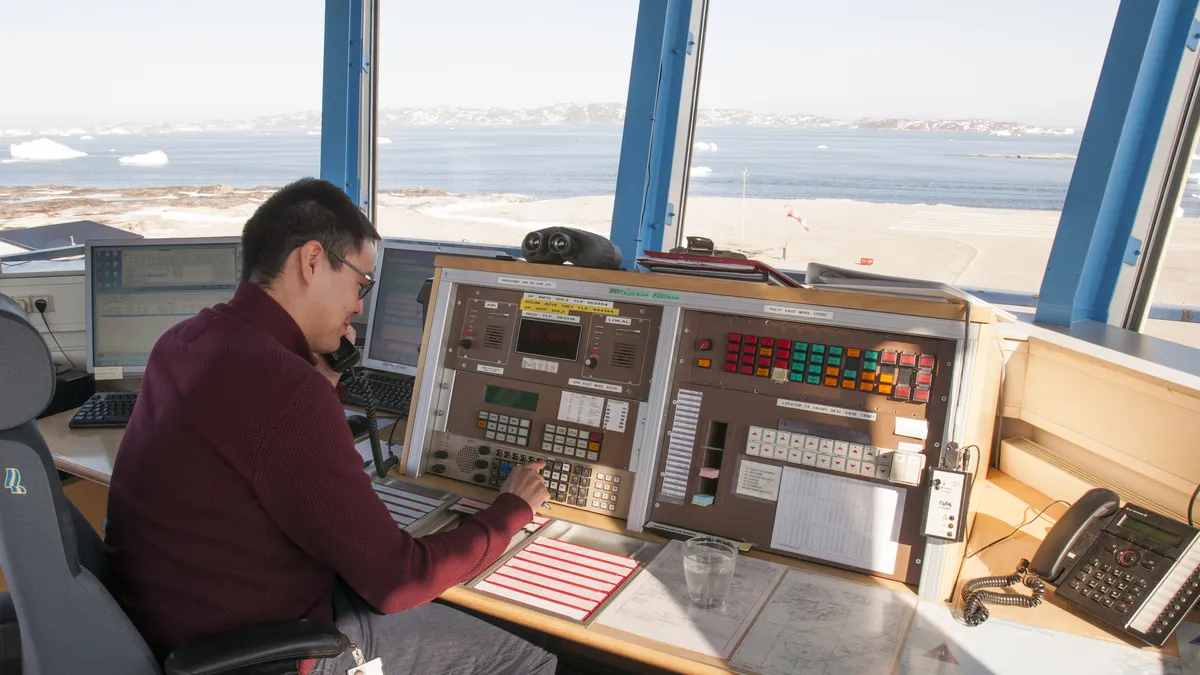
Readers who want the wider airport picture can learn how airports work as a whole, from terminals and stands to runways and taxiways. That wider picture helps explain why ground and tower teams sit in the same tower building yet handle different areas. The tower cab gives a wide view across the airfield. Screens and strips add traffic data that eyes alone cannot track. Together, view and data give the tower team a full picture.
Aircraft turnaround work between flights also shapes ground control, because servicing, fuelling, and boarding set the pace at each stand. Ground control cannot move an aircraft that still needs servicing. Controllers therefore coordinate with ground teams and watch ready times. A late pushback can change the taxi order, and a new order can change the take-off order. As a result, tower and ground teams talk often during a busy bank of departures.
How Do Controllers Sequence Landings?
How controllers sequence landings matters most when several aircraft arrive at once. Controllers build a landing order based on position, speed, height, and aircraft type. They adjust speed and heading so aircraft reach the final approach with safe space between them. They also leave room for departures between landings where the runway plan allows. A good sequence feels smooth to pilots, and it keeps the runway working at a steady pace.
Controllers start sequencing well before the airport comes into view. Approach controllers assign speeds and headings during descent. They may ask one aircraft to slow down and another to take a wider path. They may place a faster aircraft ahead of a slower aircraft when the geometry allows. However, controllers avoid sharp turns and steep descents near the ground. Smooth paths help pilots fly stable approaches and land safely.
Wake turbulence adds another layer to sequencing. A large aircraft leaves disturbed air behind it, and a smaller aircraft needs extra space behind it. Controllers adjust spacing with aircraft size in mind. They also watch wind, because wind can move disturbed air across the approach path. In addition, controllers consider runway occupancy after landing. An aircraft needs time to slow down and leave the runway, so the next landing waits for a clear runway.
Air traffic control at busy airports relies on steady sequencing more than on speed alone. A controller may hold one aircraft in a holding pattern while others land in turn. A controller may also use speed control far from the airport to avoid a hold close to the airport. The goal stays the same in both cases. Each aircraft reaches the runway in a safe order, with room to land and room to stop.
What Does Approach Control Do?
Approach control bridges the airport and the cruise. It manages aircraft climbing away from the airport and aircraft descending toward the airport. It works in a defined area around one airport or a group of nearby airports. Controllers in approach control use radar displays to track each flight. They issue headings, heights, and speeds, and they guide aircraft onto published arrival and departure paths.
For departures, approach control takes the handover from tower control after take-off. It guides the aircraft through the climb and onto the planned route. It keeps departing aircraft apart, and it keeps departures clear of arrivals. For example, a departure may turn early to stay clear of an arrival path. A departure may also climb in steps while another aircraft crosses above. Each step keeps traffic apart in three dimensions.
For arrivals, approach control takes the handover from en route control. It guides aircraft down from cruise height toward the final approach. It sets the landing sequence, and it hands each aircraft to tower control for landing clearance. Controllers may use radar vectors, which means headings that guide an aircraft onto the approach path. They may also clear an aircraft for a published approach that pilots fly with navigation aids. Either way, tower control takes over for the final landing decision.
Approach control also handles flights that stay in the local area. Training flights, survey flights, and other local traffic may need clearances inside approach airspace. Controllers fit local traffic around arrivals and departures with care. They may ask a local flight to hold clear of the approach path. They may ask a local flight to stay at a low height while a jet passes above. Clear limits keep local flying safe near busy paths.
How Does En Route Air Traffic Control Work?
En route air traffic control manages the middle part of a flight. Aircraft cruise between airports inside large sectors, and controllers manage one sector at a time. A sector covers a defined block of airspace with borders, a floor, and a ceiling. A flight crosses several sectors during a long cruise. Each crossing needs a handover, and each handover passes the flight plan, the height, and the traffic picture.
Air traffic control sectors keep the workload manageable for one controller or one team. A sector may cover a wide area with light traffic, or a smaller area with heavy traffic. Sector design changes with traffic patterns during the day. A busy sector may split into smaller pieces, and quiet sectors may combine into one larger piece. Consequently, a controller always works with a traffic load that allows safe decisions.
En route controllers check each flight against nearby traffic and against airspace restrictions. They may clear a climb to a new height, a direct route to a later navigation point, or a speed change. They coordinate climbs and descents with nearby sectors before they issue a clearance. For example, a climb may need approval from the sector above. A direct route may need approval from the sector ahead. Coordination prevents a clearance in one sector from creating a conflict in the next sector.
Long flights add another layer to en route work. How long-haul flights cross time zones and oceans shows why cruise planning, crew rest, and fuel planning matter across a long journey. En route controllers support that planning with clearances and traffic information. They also help pilots with weather avoidance during the cruise. A pilot may ask to deviate around a storm cell, and a controller checks traffic before approving the new heading.
Understanding the intricate dynamics of air traffic control not only highlights the complexities of managing airspace but also sets the stage for appreciating the broader ecosystem of the aviation industry, including the commercial strategies that airlines employ to enhance customer loyalty. Just as controllers ensure safe and efficient flight operations, airlines strive to cultivate enduring relationships with their passengers through structured rewards systems. These loyalty initiatives are meticulously designed to incentivize frequent travel and create a sense of belonging among members. For those interested in the mechanics behind these programs, a comprehensive exploration of how airline loyalty programmes work reveals the multifaceted elements that contribute to their success, from accumulating miles to navigating tiered benefits and reward seat availability.
Just as air traffic controllers orchestrate the complex ballet of aircraft movements, ensuring safety and efficiency in the skies, adventure travel operates under a similar paradigm of meticulous planning and coordination. Both domains rely on a network of experts who manage logistics and provide essential guidance to participants. In the realm of outdoor exploration, understanding how adventure travel works is crucial for a seamless experience. This process includes selecting the right equipment, understanding safety protocols, and comprehending the grading of activities, all orchestrated to empower travelers to embark on thrilling journeys while minimizing risks. Just as pilots and controllers must maintain clear communication, so too must adventure travelers engage with their guides to ensure a safe and enjoyable expedition.
How Does Aircraft Separation Work?
How aircraft separation works starts with a simple idea. Controllers keep a safe gap between aircraft in the air and on the ground. The gap uses distance, height, and time, and controllers choose the method that fits the situation. Radar, flight plans, and pilot reports all help controllers judge the gap. Controllers never rely on one source alone when traffic grows heavy. They cross-check the picture and act early when a gap starts to shrink.
Controllers separate traffic sideways, vertically, and along the route. Sideways separation uses different routes or headings. Vertical separation uses different heights. Along-route separation uses speed and time spacing on the same route. A controller may combine methods, for example by assigning a new height and a new speed together. The mix gives flexibility when weather or traffic closes one option. In contrast, a single method alone may fail when two aircraft converge quickly.
Separation rules vary by country, by airspace type, and by the tools in use. Controllers apply the rules for the airspace they manage, and they do not invent a local gap on the spot. This article therefore avoids any single distance or height as a universal rule. Readers should treat separation as a set of approved gaps, not as one magic number. A controller applies the approved gap for the tools, the traffic, and the airspace in front of them.
How railway signalling keeps trains apart offers a useful comparison, because railways also use blocks, signals, and timetables to prevent conflicts. Railways run on fixed tracks, however aircraft move freely in three dimensions. Controllers therefore manage a moving picture with more freedom and more uncertainty. The railway comparison helps readers see why sectors, routes, and clearances matter so much in the sky.
Why Do Flight Levels Matter?
Flight levels explained in simple terms means this: aircraft cruise at assigned heights based on pressure, not on height above local ground. A flight level gives every aircraft and every controller the same height reference in the cruise. Pilots set a standard pressure setting when they climb through the transition point. Controllers then assign flight levels with a shared reference across a wide area. As a result, height separation stays consistent even when local pressure changes.
Controllers assign flight levels to keep opposite-direction traffic apart and to manage climbs and descents. One direction may use one set of levels, and the opposite direction may use another set. The pattern reduces head-on conflicts on busy routes. However, controllers still check each assignment against nearby traffic. A level change needs coordination, especially near sector borders and near busy crossing routes.
Aircraft performance also shapes level assignments. A heavy aircraft may climb slowly, and a light aircraft may reach cruise height sooner. Weather may force a level change, and traffic may block the preferred level. Controllers weigh all three factors before they clear a climb or a descent. They may offer an intermediate level while they coordinate a higher level. Pilots accept the clearance, and they report when they reach the new level.
What Is a Holding Pattern?
Holding pattern explained in plain language means this: an aircraft flies a set oval-shaped path while it waits for a clearance to continue. The pattern holds the aircraft in a known area at a known height. Controllers use holds to manage arrival flow, to wait for weather to improve, or to resolve a traffic conflict. Pilots fly the pattern with set turns and set timing. Controllers know where the aircraft will stay, so they can plan other traffic around the hold.
Controllers try to avoid holds when they can. Speed control and early delays often work better than a hold close to the airport. However, a hold gives a safe and predictable way to wait when the arrival flow backs up. For example, a runway closure may force several arrivals to hold at once. Controllers stack holds at different heights, with one aircraft above another. Each aircraft descends to the next level only when the aircraft below leaves the hold.
Passengers may notice a hold as a series of gentle turns with no clear progress toward the airport. Pilots keep passengers informed when they can, and they watch fuel during the wait. Controllers also watch fuel indirectly by keeping holds as short as possible. A long hold may force a diversion to an alternate airport. Flow managers therefore try to delay departures on the ground instead of stacking holds in the air. Ground delay burns less fuel and keeps the arrival flow safer.
How Does Air Traffic Control Radar Work?
Air traffic control radar explained starts with a distinction between two kinds of radar. Primary radar sends out radio signals and listens for reflections from aircraft. It shows position without needing equipment in the aircraft. Secondary radar asks a transponder in the aircraft to reply with identity and height data. Controllers combine both pictures, and they also use flight plan data. The combined display shows each aircraft with a label, a height, and a speed trend.
Radar helps controllers track traffic, however radar alone does not control traffic. Controllers still issue clearances, and pilots still fly the aircraft. Radar coverage also has limits near the ground, behind terrain, and over remote areas. Controllers use procedural control where radar coverage ends or where radar data stays limited. Procedural control uses position reports, time, and planned routes instead of a live radar picture. Pilots report passing each navigation point, and controllers build the picture from those reports.
Modern displays add more than raw radar returns. Controllers see weather overlays, airspace borders, route lines, and conflict alerts on the same screen. Alerts warn a controller when two aircraft may lose safe spacing. The controller then acts with a new clearance before the gap closes. In addition, controllers use data links and voice radio together. Data links carry routine messages, while voice radio handles urgent and complex instructions.
Radar data also helps approach and en route teams coordinate handovers. A receiving controller sees the aircraft before the handover call. The receiving controller checks the height, the route, and the nearby traffic. The handover then runs smoothly because both controllers share the same picture. Similarly, a tower controller may use a radar display to check the final approach. Eyes still watch the runway, however the display adds traffic behind and beside the airport.
How Does Controller Pilot Communication Work?
Controller pilot communication follows strict habits for a clear reason. Radio speech must stay short, clear, and free of doubt. Controllers use standard words and phrases, and pilots read back key parts of each clearance. Readback lets the controller catch a misunderstanding at once. A pilot who hears a wrong height or a wrong runway can correct the error before acting. Therefore, readback protects both sides from a simple slip.
A typical exchange follows a set pattern. The pilot calls with identity, position, and request. The controller answers with a clearance or an instruction. The pilot reads back the clearance with the key details. The controller confirms the readback or corrects it. For example, a take-off clearance includes the runway and the aircraft identity. A landing clearance includes the runway and any wind information the pilot needs. Short exchanges keep the frequency free for other traffic.
Controllers also manage the radio frequency itself. A busy frequency needs discipline, because every extra word blocks another aircraft. Pilots listen before they speak, and they keep routine calls brief. Controllers prioritise urgent calls, and they may ask other pilots to stand by. In addition, controllers speak at a steady pace with clear numbers. Rushed speech causes errors, and errors cost time and safety.
Language differences add risk, so standard phraseology matters even more on international routes. Controllers and pilots use agreed English phrases for control instructions in many places. Local languages may serve other airport services, however control instructions follow the agreed standard. Training drills standard phrases until they feel automatic. As a result, a pilot from one country and a controller from another country can share a clear picture.
How Does Weather Affect Air Traffic Control?
How weather affects air traffic control starts with visibility. Low cloud, fog, and heavy rain can hide the runway and the taxiways. Tower controllers then rely more on radar displays, ground radar, and pilot reports. Pilots need more spacing in low visibility, and take-off and landing rates fall. Controllers adjust the flow rather than force the same rate through poor visibility. Safety sets the pace, and the schedule follows.
Thunderstorms create a different problem. Pilots avoid storm cells by a safe margin, and deviations can cross nearby routes. Controllers coordinate deviations with nearby sectors and with other traffic. A single storm cell can force several aircraft onto new headings at once. Controllers therefore build extra space around storm areas before traffic reaches them. They may also reroute arrivals onto a different approach path.
Wind shapes runway choice and spacing. A strong crosswind may close one runway direction for some aircraft. A tailwind may force a runway change for safe landing performance. Controllers watch wind reports from pilots and from airport sensors. They may change the runway plan during a shift when the wind shifts. Pilots receive the new plan with enough time to prepare a new approach.
Ice, snow, and volcanic ash add ground and air risks. De-icing takes time at the stand, and snow clearing takes time on runways and taxiways. Controllers sequence departures around de-icing and clearing work. Volcanic ash may close large blocks of airspace until experts assess the risk. Flow managers then reroute or delay flights around the affected area. In each case, controllers share the reason for delay with pilots, and pilots share the reason with passengers when they can.
How Does Air Traffic Flow Management Work?
Air traffic flow management balances demand with capacity across a network. Demand means the number of flights that want to use a sector, a route, or an airport at one time. Capacity means the number of flights that controllers can handle safely at that time. Weather, staffing, equipment, and airspace closures can all cut capacity. Flow managers act early, before demand exceeds capacity in the air.
Flow managers use ground delays, reroutes, and level caps to spread demand. A ground delay holds a flight at the departure airport until a slot opens at the destination. A reroute sends a flight around a congested sector. A level cap limits climbs into a busy sector. Each measure shares delay fairly and keeps the air picture manageable. For example, a short ground delay at departure may prevent a long hold near the destination. The trade saves fuel and keeps arrival spacing safe.
Airlines, airports, and control centres share data for flow decisions. Airlines share ready times and fuel limits. Airports share runway capacity and ground constraints. Control centres share sector capacity and weather impacts. Flow managers weigh all the inputs and publish a plan. Controllers then apply the plan sector by sector. However, the plan stays flexible, and flow managers update it as weather and traffic change.
How flight booking systems present fare classes and codeshares explains the passenger-facing side of a journey, while flow management explains the network side. A booked seat does not guarantee a departure time when capacity falls. Flow managers protect safety first, and they restore normal flow as soon as capacity returns. Travellers feel the result as a delay, however the delay often prevents a worse delay in the air.
What Changes at Busy Airports?
Air traffic control at busy airports uses the same rules as elsewhere, however the pace and the coordination grow tighter. Controllers manage more aircraft in the same area, and handovers happen more often. Ground control, tower control, and approach control coordinate runway use minute by minute. A small delay at one stand can ripple through the taxi order and the departure order. Teams therefore plan each bank of flights with a shared runway plan.
Busy airports also use more structure. Published departure and arrival routes separate flows, and holding areas wait at set points. Controllers assign speeds early, and they keep aircraft on predictable paths. Predictability helps every controller in the chain. A pilot who follows a published path needs fewer headings, and a controller can plan the next move sooner. In contrast, free-form vectors suit light traffic better, because they need less fixed structure.
Airlines shape busy-airport work too. How airlines plan routes, hubs and fleets helps explain why many flights arrive and depart in clusters. Hub banks create peaks, and controllers staff and plan for those peaks. Airport security and boarding procedures also shape departure timing, because late boarding can delay pushback and taxi. Controllers absorb small delays with taxi order changes. Large delays need flow management across the network.
At a busy airport, a controller may work with a colleague at the same position. One person talks on the radio while the other coordinates and tracks strips. The split keeps radio work clear during a surge. Supervisors watch the whole airport picture and open extra positions when traffic rises. As a result, busy airports scale the team to match the traffic, not only the airspace. The chain stays the same, however more hands share the work.
Why Does the Chain Matter for Travellers?
Travellers feel the chain in delays, in smooth arrivals, and in safe landings. A ground delay may feel frustrating at the gate, however it may protect a safe arrival slot later. A holding pattern may feel like wasted time, however it keeps the landing order safe. A reroute may add minutes, however it may avoid a storm or a congested sector. Each control decision trades a small cost now for safety and order later.
Travellers can also use the chain picture to read a journey better. A pilot announcement about flow control points to network capacity, not to a fault with the aircraft. An announcement about a new runway plan points to wind or traffic, not to confusion in the tower. A go-around points to a safe decision, not to a failed landing. Pilots and controllers choose a go-around when the approach or the runway needs more space. The aircraft climbs away, rejoins the approach flow, and lands when the picture clears.
What Should Travellers Take Away?
The chain also explains why one delay can affect later flights. An aircraft, a crew, and a gate all move from one flight to the next. A late arrival can delay the next departure for the same aircraft. Flow managers and airlines work together to recover the plan. Controllers help by keeping the current flight moving safely through each link. Passengers gain most when every link stays honest about time, weather, and capacity.
How air traffic control works, in the end, comes down to people, structure, and clear speech. Controllers divide the sky into manageable pieces. Routes, levels, and clearances give every flight a known path. Pilots and controllers check each other with readbacks and handovers. Weather and demand test the system every day, and flow management spreads the pressure. The result lets aircraft share busy skies with order, patience, and a steady focus on safety.