
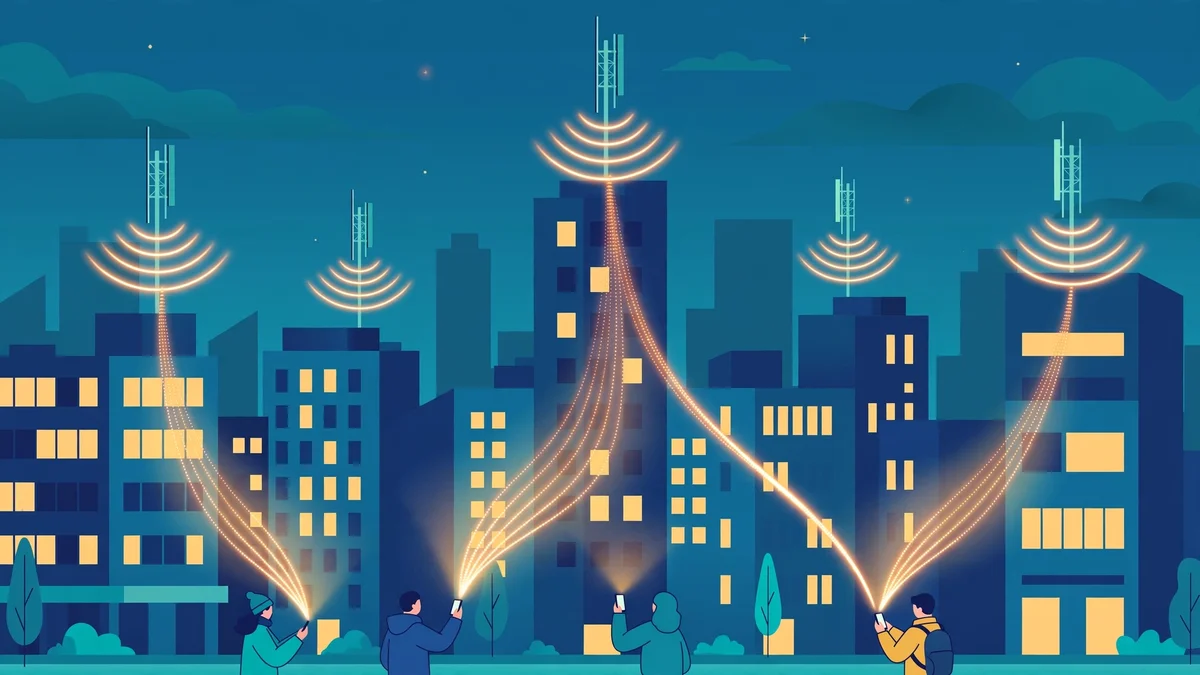
Your video starts before you finish tapping play. A map updates while you drive. A video call stays clear, even in a crowded station. None of this is luck. Behind it sits a mobile network that has quietly changed how your phone talks to the world.
So how does 5g work, exactly? This guide answers that question in plain language. You will learn what 5G is, how your phone connects to it, why it feels faster than 4G, and what it can and cannot do. No engineering degree is needed. By the end, the network in your pocket should make a lot more sense.
What Is 5G, in Plain Words?
5G stands for fifth generation. It is the fifth major version of mobile network technology, following 1G, 2G, 3G and 4G. Each generation improved on the one before it. 1G carried voice calls. 2G added text messages. 3G brought the mobile internet. 4G made video streaming normal. 5G builds on all of that, with faster speeds, shorter delays and room for far more connected devices.
Think of it like a road system. 4G is a busy motorway that works well most of the time. 5G is a wider, smarter motorway with extra lanes, better junctions and traffic lights that adapt to the flow. The cars are the same, but the road handles more of them, more smoothly, at the same time.
One thing worth clearing up early: 5G is not a single invention. It is a set of standards and technologies that work together. Different countries and networks roll it out in different ways. As a result, your experience of 5G can vary a lot depending on where you are and which phone you use.
How Does 5G Work, Step by Step?
Every time your phone uses 5G, the same basic journey repeats. Your phone sends a request. The network carries it. An answer comes back. Here is that journey, one step at a time.
Step 1: Your Phone Talks to a Nearby Cell
Your phone is always listening for a network. When it finds 5G coverage, it connects to the nearest cell site. A cell site is a small area served by antennas, usually mounted on a tower, a rooftop or a lamppost. Your phone talks to that site using radio waves.
Radio waves are invisible waves of energy that travel through the air. They carry your data as tiny pulses. Your phone sends them out, and the cell site picks them up. Then the site sends waves back, and your phone picks those up. This two-way exchange happens constantly, thousands of times a second.
Unlike the big towers you may picture, 5G often uses many smaller sites. These are called small cells. They sit closer together and cover smaller areas. Because they are closer to your phone, the signal stays strong. This design is one of the main reasons 5G can handle crowded places, such as stadiums and city centres. If you enjoy seeing how other large systems coordinate many moving parts, our guide to how air traffic control works shows a similar idea: many small, local decisions adding up to one smooth system.
Step 2: Radio Waves Carry the Data
Once connected, your data travels as radio waves between your phone and the cell site. The waves move at the speed of light, so the trip itself is almost instant. What matters more is how much data each wave can carry, and how cleanly it arrives.
5G uses a wider range of radio frequencies than 4G. Frequencies are the different “lanes” in the radio spectrum. Some lanes are wide and fast but short-range. Others are narrow and slower but travel far. 5G can use several lanes at once, which is a big part of its speed advantage.
There is a trade-off, though. High-frequency waves carry more data but struggle with walls, trees and rain. Low-frequency waves travel further and pass through obstacles more easily, but they carry less data. A good network mixes both, so you get speed where possible and coverage where needed.
Step 3: The Network Routes Your Request
After the cell site receives your data, it passes it into the core network. The core is the brain of the operation. It checks who you are, confirms your plan, and decides where your request should go. Then it sends the request onward, usually through fibre-optic cables, to the internet or to another service.
Fibre-optic cables carry data as pulses of light through thin glass strands. They are far faster than old copper wires. In fact, most of a 5G journey happens on fibre, not in the air. The wireless part is only the last stretch, from the cell site to your phone. That is a useful detail to remember, because it explains why 5G can feel instant even when the nearest tower is far away.
This routing step is similar to how other everyday systems work. When you book a flight online, for example, your request travels through several connected systems before an answer comes back. Our explainer on how flight booking systems work follows the same kind of journey, from a single tap to a confirmed result.
Step 4: The Answer Comes Back
Finally, the answer travels the same route in reverse. The server sends the video, the message or the web page back through the core network, to the cell site, and then by radio waves to your phone. Your phone turns those waves back into pictures, sound and text.
The whole round trip can take less than a blink. The delay between sending a request and receiving a reply is called latency. On 4G, typical latency is around 30 to 50 milliseconds. On a good 5G connection, it can fall to around 10 milliseconds or less. That difference is small in absolute terms, but it matters a lot for video calls, online gaming and anything that needs an instant response.
The Three Kinds of 5G Spectrum
Not all 5G is the same. Networks use three bands of spectrum, and each one behaves differently. Understanding the three bands explains why 5G feels fast in one place and ordinary in another.
| Band | Speed | Coverage | Best for |
|---|---|---|---|
| Low band (below 1 GHz) | Similar to good 4G | Wide, travels far, passes through walls | Countryside and indoor coverage |
| Mid band (1 to 6 GHz) | Clearly faster than 4G | Medium range, decent through walls | Cities and suburbs, most daily use |
| High band (above 24 GHz, mmWave) | Extremely fast | Very short range, blocked by walls | Stadiums, stations and dense crowds |
Low band is the workhorse. It reaches far and wide, so it gives most people their first taste of 5G. Mid band is the sweet spot for most users, because it balances speed and coverage. High band, also called millimetre wave, is the showpiece. It can deliver remarkable speeds, but only over short distances with a clear line of sight.
Most of the time, your phone moves between these bands without you noticing. It picks the best available option for where you are standing. If you walk into a building, it may drop from high band to mid band. If you leave a city, it may fall back to low band, or even to 4G. This handover happens in the background, and it is one reason the network feels seamless.
Four Technologies That Make 5G Different
Speed alone does not explain 5G. Four technologies work behind the scenes, and each one solves a different problem. Together, they are what make 5G more than just a faster 4G.
Massive MIMO: Many Antennas at Once
MIMO stands for multiple input, multiple output. In plain terms, it means using many antennas at the same time to send and receive data. A 4G tower might use a handful of antennas. A 5G site can use dozens.
Picture a post office with one counter, then picture the same office with thirty counters. The queue moves faster, and more people get served at once. Massive MIMO does the same thing for data. It lets a single cell site serve many phones at the same time without slowing down. This matters most in crowded places, where hundreds of phones compete for the same signal.
Beamforming: Aiming the Signal at You
Older mobile networks broadcast their signal in all directions, like a light bulb. 5G can aim its signal at a specific phone, like a torch. This technique is called beamforming.
By aiming the signal, the network wastes less energy and delivers a stronger connection to each user. It also reduces interference between phones. The result is a cleaner, more reliable link, even when you are moving. Beamforming works together with massive MIMO, because many antennas make it possible to shape and steer these beams precisely.
Small Cells: More Sites, Closer Together
As noted earlier, 5G relies on many small cell sites instead of a few huge towers. A small cell might sit on a lamppost, a bus stop or the side of a building. Each one covers a small area, but there are many of them.
This dense layout has two benefits. First, your phone is usually close to a site, so the signal is strong. Second, each site serves fewer people, so nobody has to share the connection with a huge crowd. The trade-off is cost and effort: building thousands of small sites takes more time and planning than raising a few tall towers.
Network Slicing: One Network, Many Virtual Networks
Network slicing lets a single physical 5G network act like several separate networks. Each “slice” is tuned for a different job. One slice might prioritise speed for video streaming. Another might prioritise reliability for emergency services. A third might prioritise battery life for small sensors.
Think of a hospital with separate wards. Each ward shares the same building, but each one is set up for its own patients. Network slicing works the same way. It gives each type of use exactly what it needs, without building a whole new network for every purpose. This idea is still growing, but it is one of the most important parts of 5G’s long-term promise.
5G vs 4G: What Is Actually Different?
People often ask whether 5G is simply faster 4G. The honest answer is that speed is only part of the story. Here is a side-by-side look at the main differences.
| Feature | 4G | 5G |
|---|---|---|
| Typical download speed | Fast enough for HD video | Several times faster, enough for 4K and beyond |
| Latency | Around 30 to 50 milliseconds | Can fall below 10 milliseconds |
| Devices per area | Thousands | Up to a million per square kilometre in theory |
| Best for | Phones, tablets, streaming | Phones plus cars, sensors, factories and cities |
The device count is the change that matters most for the future. 4G was built mainly for people with phones. 5G was built for people plus machines: sensors, vehicles, medical devices, factory robots and smart city equipment. That is why engineers talk about the Internet of Things so often when they talk about 5G. The network is designed to connect far more things than phones alone. If that world of connected machines interests you, our simple guide to how soft robots work shows one kind of machine that benefits from fast, reliable wireless links.
For everyday phone use, though, the difference is often modest. If you mainly browse, message and watch videos, a good 4G connection already does the job well. 5G shines brightest in crowded places, in large downloads, and in new uses that need instant responses.
What Can 5G Do That 4G Cannot?
So what is 5G actually for? Beyond faster phones, it opens the door to uses that 4G struggles with. Here are the ones most often discussed.
First, remote work and learning get smoother. A low-latency connection makes video calls feel natural, with less lag and fewer frozen faces. That matters when a whole class or team meets online at the same time.
Second, connected vehicles become more realistic. Cars that share information with each other and with traffic systems need instant, reliable links. A delay of even a fraction of a second matters at motorway speed. 5G’s low latency helps here, although self-driving cars still depend on many other technologies too. Rail networks face the same challenge on a bigger scale, and our explainer on how high-speed rail works shows how dedicated lines and signalling keep fast trains safe and on time.
Factories, Health and Entertainment
Third, factories and farms can connect thousands of sensors. A sensor that reports soil moisture, or a machine that reports a fault, does not need much speed. It needs a network that can handle huge numbers of small devices cheaply. 5G is designed for exactly that.
Fourth, healthcare gains new options. A doctor guiding a procedure from another city, or a patient monitor sending live data, needs a connection that rarely drops. 5G’s reliability and slicing make that kind of link more practical than before.
Finally, entertainment changes. Cloud gaming, virtual reality and augmented reality all need fast, steady data. With 5G, the heavy computing can happen on a distant server, while your phone or headset simply shows the result. That makes powerful experiences possible on light, portable devices. The same fast link helps artificial intelligence tools, which also do their heavy thinking on distant servers; our guide to how artificial intelligence works explains the data and patterns behind those answers.
Common 5G Myths, Cleared Up
Because 5G is new and invisible, myths spread quickly. Let us look at the most common ones, calmly and with evidence.
Myth 1: 5G is dangerous to health. 5G uses radio waves, the same kind of energy that carries radio, television and Wi-Fi. These waves are non-ionising, which means they do not carry enough energy to damage DNA the way X-rays can. Health agencies around the world, including the World Health Organization, have reviewed the evidence and found no confirmed health risk from mobile networks operating within safety limits. If you want to practise checking claims like this for yourself, our guide to learning statistics and reading data with confidence explains how to weigh evidence before believing a headline.
Myth 2: 5G causes the weather or spreads illness. There is no mechanism by which radio waves could cause either. This claim spread widely on social media, but it has no support in physics or in any credible study. A good habit is to ask what evidence would prove a claim, and whether that evidence exists.
Myth 3: 5G will make Wi-Fi or fibre obsolete. In fact, 5G depends on fibre. Most cell sites connect to the rest of the network through fibre-optic cables. Wi-Fi also remains the best option inside most homes and offices, because it is cheap and reliable. 5G, Wi-Fi and fibre complement each other. They are partners, not rivals.
One More Myth: Do You Need a New Phone?
Myth 4: You must buy a 5G phone right now. You do not. 4G networks will keep working for years. A 5G phone is worth considering when you next upgrade, especially if you live in an area with good coverage. Until then, your current phone is fine.
When a new technology arrives, strong claims follow it. The best defence is a calm look at the evidence. That is also a useful study skill in general, and our article on learning science by replacing misconceptions with working models explains why old ideas are so hard to shift, and how to replace them with better ones.
Do You Need a 5G Phone?
The short answer is: it depends on where you live and how you use your phone. Here is a simple way to decide.
Check coverage first. If your town or city has strong 5G coverage, you will notice the difference more. If coverage is thin, a 5G phone will spend most of its time on 4G anyway. Coverage maps from network operators give a rough idea, though real-world signal can vary from street to street.
Next, think about what you do. Large downloads, 4K streaming, cloud gaming and video calls benefit most. Browsing, messaging and music streaming work well on 4G already. If your phone is old and due for replacement, choosing a 5G model costs little extra now, and it keeps your options open.
One more practical point: 5G can use more battery than 4G, because the phone works harder to hold a fast connection. Most modern phones manage this well, and they switch back to 4G when 5G is not needed. Still, if battery life matters to you, it is worth knowing.
How to Learn More About the Networks Around You
Curiosity is the best tool for understanding technology. You do not need special equipment to explore how 5G works where you live. In fact, the best way to understand how does 5g work in practice is to watch your own phone as you move around.
Start by checking your phone’s status bar. It usually shows 4G, 5G or 5G+ when you are connected. Walk around your neighbourhood and watch how it changes. Notice where the signal is strong and where it drops. You are seeing the cell layout of your area in real time.
Next, try a simple speed test in different places: at home, in a park, in a busy shopping area. Compare the results. You will often find that the busiest places benefit most from 5G, which is exactly what the technology was designed for.
Finally, look up. Cell sites are hiding in plain sight: on rooftops, lampposts and poles. Once you start noticing them, you will see them everywhere. A network that felt invisible suddenly becomes visible.
If you want to go deeper, the skill that matters most is learning how to learn. Our guide to attention and focus while studying explains why short, focused sessions beat long, distracted ones — a useful habit when you are working through any technical topic.
Frequently Asked Questions About How 5G Works
How does 5G work in simple terms?
Your phone sends data by radio waves to a nearby cell site. The site sends it through fibre-optic cables to the core network, which routes it to the internet. The answer comes back the same way. That round trip, using many antennas, aimed signals and small cells, is how does 5g work in everyday use.
Is 5G faster than home Wi-Fi?
Sometimes, but not always. A good fibre connection with modern Wi-Fi can be faster and more stable than 5G. 5G wins when you are out and about, away from Wi-Fi. At home, Wi-Fi is usually the better choice.
Does 5G work in rural areas?
Yes, but more slowly. Low-band 5G reaches rural areas well, and its speeds are similar to good 4G. High-band 5G rarely reaches the countryside, because its range is short and it needs many small sites.
Will 5G replace 4G?
Eventually, but not soon. 4G and 5G share the same towers and spectrum in many places. Networks will run both side by side for years, and 4G phones will keep working.
Why does my phone show 5G but feel slow?
Several reasons are possible. You may be on low-band 5G, which is only slightly faster than 4G. The cell site may be busy. Or the website or app you are using may be slow, which has nothing to do with your connection. Speed depends on the whole chain, not just the last link.
Does 5G use more data?
Not by itself. A faster connection does not create data. However, people tend to watch more video and download larger files when the connection is fast, which can use more data. Check your plan’s allowance if you stream a lot.
The Bottom Line
How does 5g work? In short, your phone talks to a nearby cell site using radio waves. The site passes your request through a fibre-connected core network, and the answer comes back the same way. Spectrum bands, many antennas, aimed signals, small cells and network slicing make the whole system faster, more reliable and able to serve far more devices than 4G.
For most people, 5G is not a revolution you will feel every day. It is a quiet upgrade that matters most in crowded places, in large downloads, and in the new uses it makes possible. The network will keep improving as more sites are built and more devices connect. Now, when your video starts instantly, you will know what happened behind the screen — and why it works.
What will you notice first about 5G where you live? Take a walk, watch your signal, and see the network in action. The best way to understand a technology is to observe it working in your own daily life.