
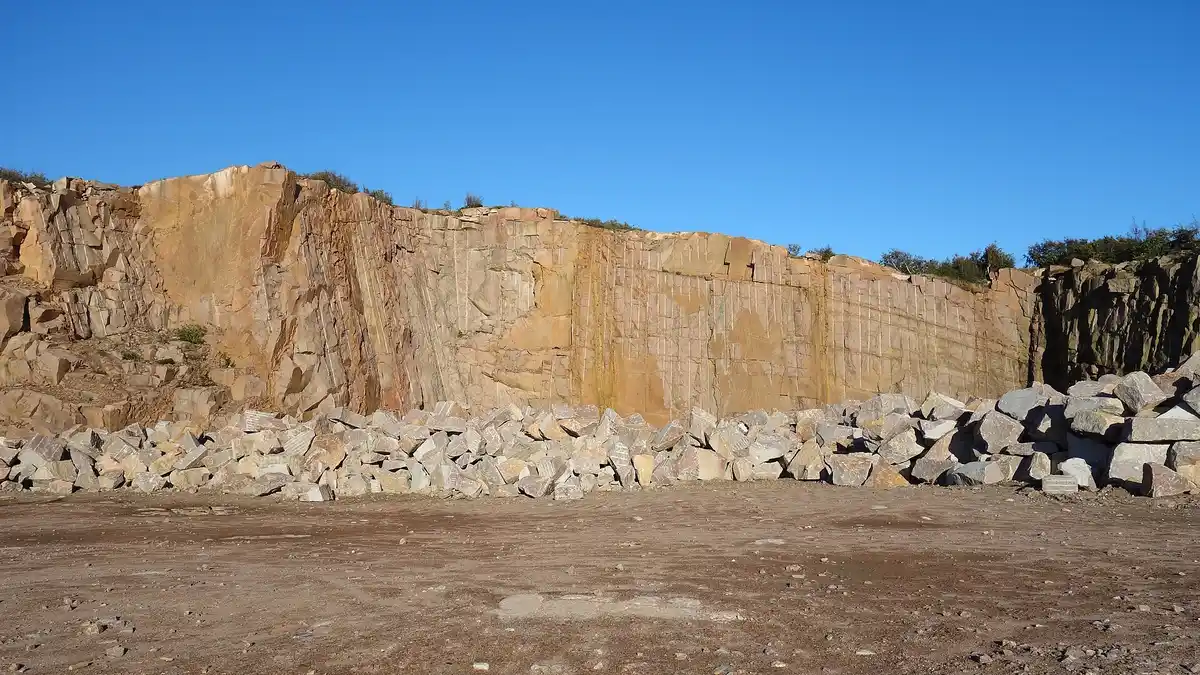
The journey has clear stages. First, workers find the right rock and open a quarry. Then, they cut blocks, shape them, and carry them to site. After that, masons lay them into walls, fix them onto facades, or set them into paving. In short, this guide follows one block from the quarry to the building, with each stage in order. Along the way, you will meet the quarry face, the cutting shed, the dressing bench, and the mason’s wall.
Where does building stone come from?
Building stone comes from quarries, which are open pits where workers cut rock from the ground. A quarry opens where the rock suits building: strong, even, and free of deep cracks. In addition, the quarry must sit close enough to roads or rail, since stone is heavy and costly to move. As a result, most building stone travels only a short distance from quarry to site. In short, stone quarrying explained means cutting usable blocks from a rock face and shaping them for building.
What is a stone quarry?
A stone quarry is a working pit with stepped faces, roads, and cutting sheds. Workers open the ground in benches, which are wide steps that let machines reach each level. In addition, the quarry floor holds the blocks, the cutting saws, and the loading area. Therefore, a quarry looks like a giant staircase cut into the hillside. For example, a granite quarry shows pale stepped faces, while a sandstone quarry shows warm layered walls. In practice, the quarry grows deeper and wider as workers take more stone, and the benches move down with them.
How do workers find good stone?
Workers find good stone by reading the rock. They look for even colour, fine grain, and few cracks. In addition, they test small samples for strength and weathering before they open a new face. Therefore, the search starts with the eye and ends with the test. As a result, a quarry opens only where the rock passes both checks. For instance, a stone with hidden cracks will split during cutting, so workers reject that face and move on. In short, finding stone is a slow job, and a good quarry repays the care with decades of steady blocks.
How do workers extract stone from a quarry?
Workers extract stone by cutting blocks free from the rock face, one block at a time. They mark the block, cut its sides, and then free its base. In addition, they lift the block with a crane or loader and carry it to the cutting shed. As a result, each block leaves the face in one piece, ready for shaping. In short, quarry extraction methods explained means the ways workers free blocks from the rock face without shattering them.
What extraction methods do quarries use?
Quarries use several methods, and the choice depends on the rock. Hard rock needs wire saws, which cut with a loop of wire and grit. Softer rock yields to chain saws, which cut like a giant chain. In addition, workers still use wedges and feathers, which are steel wedges that split the rock along a line of holes. Therefore, the method follows the stone: hard stone gets the wire saw, soft stone gets the chain saw, and splitting suits stone with a clear grain. As a result, the quarry keeps several methods ready, and the foreman picks the one that suits each face. For example, a limestone face with even layers splits cleanly with wedges, while a granite face needs the slow, steady wire saw.
How do workers cut stone blocks?
Workers cut blocks in the shed with large circular saws and wire saws. They mark the block, set the saw, and cut it into slabs or smaller blocks. In addition, they trim the edges square, so the blocks stack and lay neatly. In short, stone cutting explained means sawing quarry blocks into the sizes and shapes that builders need. However, cutting makes dust and noise, so workers use water to cool the blade and settle the dust. As a result, the shed stays cooler and cleaner, and the blades last longer. In practice, a single block can yield several slabs, and the offcuts become paving, steps, or rubble for fill.
What types of building stone are there?
Builders use many types of stone, yet three lead the list: granite, limestone, and sandstone. Each one forms in a different way, and each one suits different jobs. In addition, local stone often leads the list, since builders use the rock that sits nearest the site. As a result, the stone of a region shapes the look of its buildings. In short, building stone types explained means the main stones builders use and the jobs each one suits.
How do granite, limestone and sandstone differ?
Granite forms deep underground as molten rock cools slowly, so it turns out hard, speckled, and very strong. Limestone forms from shells and lime in shallow seas, so it turns out softer, paler, and easier to carve. Sandstone forms from sand pressed into rock, so it turns out warm, layered, and easy to split. In short, granite limestone sandstone construction explained means three stones, three origins, and three characters. Therefore, granite suits steps and paving that take hard wear, limestone suits carving and facades, and sandstone suits walls and paving with a warm look. For example, a busy station floor needs granite, while a carved doorway suits limestone. In practice, the stone’s origin decides its strength, and its strength decides its job.
How do builders choose the right stone?
Builders choose stone by matching the stone to the job and the climate. They check strength, porosity, colour, and cost. In addition, they check how the stone weathers, since a stone that soaks up water will fail in frost. In short, stone selection construction explained means matching stone, job, and climate together. Therefore, a dense, low-porosity stone suits wet climates, while a soft stone suits sheltered carving. As a result, the choice is never about looks alone. For instance, a pale limestone may look right for a facade, yet a granite may last longer in the same spot. In practice, builders weigh looks against life, and the longer life usually wins.
How does stone go from block to building?
A quarry block becomes a building stone through dressing, finishing, and fixing. Workers shape the block, smooth or roughen its face, and then fix it into place. In addition, each step needs its own tools and skills. As a result, the stone passes through several hands before it reaches the wall. In short, this section follows the block from the cutting shed to the finished building.
What is stone dressing?
Stone dressing means shaping a block into its final form. Workers cut the block square, trim its edges, and shape its face. In addition, they may carve a moulding or a chamfer along the edge. In short, stone dressing explained means shaping a rough block into a finished building stone. However, dressing takes time, so workers dress only the faces that people will see. As a result, the hidden faces stay rough, which also helps the mortar grip. For example, a wall stone shows a dressed face and hides rough sides and back. In practice, the mason dresses the stone on a bench with chisels and mallets, and the work is slow, skilled, and exact.
How do workers finish stone surfaces?
Workers finish stone surfaces in several ways, and each finish changes the look and the grip of the stone. A polished finish shines and suits floors and sills. A honed finish stays smooth but dull, which suits steps and worktops. A rough finish, such as a rock face or a bush-hammered face, grips well and suits walls. In short, stone finishing explained means the surface treatment that sets the look and the grip of a stone. Therefore, the finish follows the job: smooth for floors, rough for walls, polished for show. As a result, the same stone can look very different with a different finish. For instance, a polished granite step looks smart, yet it can turn slippery when wet, so workers often choose a flamed or honed finish for steps instead.
How do fixing systems hold stone in place?
Fixing systems hold stone panels and blocks onto the building frame. Workers use stainless steel brackets, pins, and anchors that grip the stone and tie it back to the structure. In addition, the fixings must carry the weight of the stone and resist wind. In short, stone fixing systems explained means the brackets, pins, and anchors that tie stone to a building. However, the fixings must also let the stone move slightly, since stone swells and shrinks with heat and damp. As a result, the system holds the stone firm yet lets it breathe. For example, a cladding panel hangs on two brackets and rests on a third, so its weight spreads across the frame. In practice, the fixing design matters as much as the stone, since a weak fixing will drop a panel no matter how good the stone is.
How is stone used in buildings?
Stone serves buildings in many ways: as walls, cladding, paving, and steps. Each use asks something different from the stone. Walls need strength and mass. Cladding needs a neat face and a light fixing. Paving needs grip and wear. As a result, the same quarry can supply several uses, and each use takes a different cut. To see how walls carry loads, read our guide on how loads travel through a building.
What is stone cladding?
Stone cladding is a thin skin of stone fixed onto a building frame. It gives the look of solid stone without the weight of a full stone wall. In addition, the gap behind the cladding lets air flow, which keeps the wall dry. In short, stone cladding explained means a thin stone skin on a frame, with a drained gap behind it. However, cladding needs careful fixing, since each panel hangs on brackets. As a result, designers check the wind loads and the fixing strength before they choose the panel size. For example, a tall tower needs smaller panels and stronger fixings than a low house. In practice, cladding lets modern frames wear a stone face, and the building gains the look of stone with the speed of a frame. For frames, read our guide on how reinforced concrete frames work.
How do workers build stone walls?
Workers build stone walls by laying blocks in courses, which are level rows that run along the wall. They set each block in mortar, check it level, and pack the joints. In addition, they tie the wall together with long stones that span its thickness. In short, stone wall construction explained means laying dressed blocks in level courses with mortar joints. However, the wall needs a sound footing, since stone is heavy and will settle on soft ground. As a result, masons start with a firm base and build up slowly. For example, a garden wall may rise in a day, while a house wall takes weeks of steady courses. In practice, the mason’s eye and level decide the wall, and a straight, plumb wall shows the skill at once. To see how walls like these are laid, read our guide on how masonry structures work.
Where does stone paving fit?
Stone paving covers floors, paths, and courtyards with flat stone slabs. Workers lay the slabs on a sand or mortar bed, level each one, and fill the joints. In addition, they choose a stone with grip, since wet paving must not turn slippery. In short, stone paving explained means flat stone slabs laid as a walking surface. Therefore, granite and sandstone lead the choice, since both resist wear and give grip. As a result, a stone-paved courtyard can serve for decades with little care. For instance, a busy square needs thick slabs on a firm base, while a garden path can use thinner slabs on sand. In practice, the base decides the life of the paving, so workers build the base as carefully as they lay the slabs.
What is stone masonry?
Stone masonry is the craft of building with stone, and it covers walls, arches, and vaults. Masons cut, dress, and lay stone by hand, and they use mortar to bond the blocks. In addition, they build arches that carry loads across openings without steel. In short, stone masonry construction explained means the mason’s craft of building structures from stone blocks. However, the craft needs time and skill, so stone masonry costs more than blockwork.
As a result, builders use it where its looks and life earn the cost. For example, a stone arch over a doorway shows the craft at its best, since each block must fit its neighbour exactly. In practice, stone masonry still stands in old towns and new homes alike, and its walls outlast most other finishes. For the materials that join the stones, read our guides on brick making, cement and concrete making, and how aggregates and sand work.
How does stone age and weather?
Stone ages slowly, yet it does change. Rain, frost, sun, and air all work on its surface. In addition, pollution and salts can stain and eat into soft stone. As a result, a stone facade looks different after decades than it did on the day workers fixed it. In short, this section looks at how stone lasts, how it weathers, and what keeps it sound.
What makes natural stone durable?
Natural stone lasts because its minerals lock together into a dense, hard mass. Dense stone soaks up little water, so frost has little to grip. In addition, hard minerals resist wear from feet and weather. In short, natural stone durability explained means dense minerals, low water uptake, and hard wear. Therefore, granite outlasts limestone in wet, busy places, while limestone lasts well in dry, sheltered spots. As a result, durability is not one quality but a match between stone and setting. For example, a granite step in a rainy city can serve for a century, while a soft sandstone step in the same city may wear hollow. In practice, the denser the stone, the longer it lasts, yet even dense stone needs a sound fixing and a dry base.
How does weathering change stone?
Weathering changes stone in slow, visible ways. Rain washes the surface and can dissolve soft minerals. Frost freezes water in pores and cracks, which splits the surface. Sun heats the face and cools it again, which opens tiny cracks over time. In addition, salts from the ground can rise into the stone and crystallise, which pushes the surface off in flakes. In short, stone weathering explained means rain, frost, sun, and salts slowly changing a stone’s surface. However, weathering is not always harm.
A weathered stone gains colour and character, and many old buildings look better for it. As a result, builders accept some weathering and plan for it. For instance, they set a drip edge so rain falls clear of the wall, and they choose dense stone for sills and copings that take the worst weather. In practice, good detailing slows weathering more than any coating can. Wind also shapes stone over time, and our guide on how buildings stand up to wind explains the forces at work. For the renders that protect walls, read our guide on how plaster, render and screed work.
How do workers repair old stonework?
Workers repair old stonework by first finding the cause of the damage. They check whether water, salts, or a failed fixing caused the harm. In addition, they test the stone to see how deep the damage runs. Therefore, the repair starts with diagnosis, not with tools. As a result, the fix matches the fault, and the repair lasts. For example, a stone that flakes from salts needs the salt source cut off first, since a new face will flake again if the salts stay. In practice, masons replace only the stones that have failed, and they match the new stone to the old in colour and grain. They also use a lime mortar that lets the wall breathe, since a hard cement mortar can trap water and crack the stone beside it. In short, repair is slow, careful work, and it keeps old stone buildings standing for the next generation.
What should you remember about stone in construction?
Stone starts in a quarry, where workers cut blocks from the rock face. Saws and wedges free the blocks, dressing shapes them, and fixings hold them in place. Cladding, walls, paving, and masonry each use the stone in a different way. In short, this is how stone is quarried used construction in one picture: rock face to cutting shed, shed to site, and site to a wall that can last for centuries.
When you choose stone, start with the job and the climate, not with the colour alone. Ask what the stone must carry, how wet it will get, and how much wear it will take. Then match the stone, the finish, and the fixing to those answers. A stone that suits a sheltered carving will fail as a busy step, so the setting decides. In the end, stone rewards patience: quarry it well, dress it well, fix it well, and it will outlast the building around it — and the next one built beside it. That long life is the real reason builders keep coming back to stone.